I Asked Science How Hard a Human Can Fart (A Rigorous Investigation)
April 12, 2026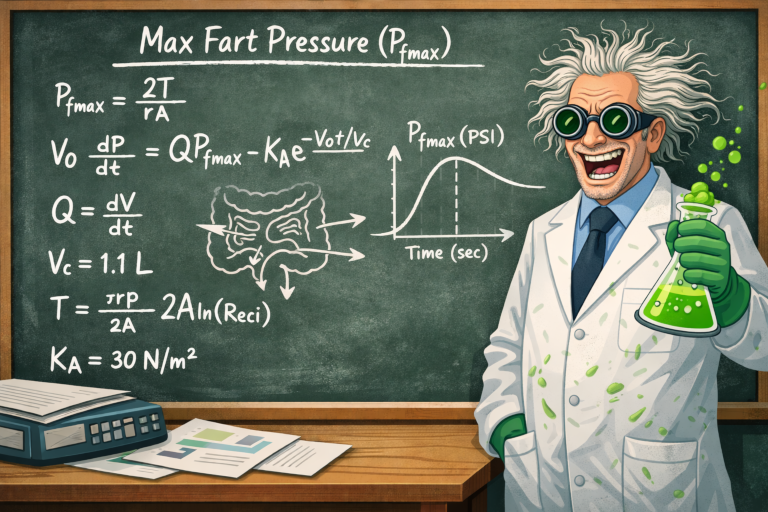
Share this post


It is Sunday. The coffee is hot. The world is quiet. And I have decided, with full adult agency and a functioning frontal lobe, to spend my morning calculating the maximum pressure a human being can generate during a fart.
Someone had to.
Background and Motivation
Look. Every great scientific endeavor begins with a question. Newton had gravity. Einstein had relativity. I have this.
The question: what is the maximum PSI a human fart can achieve?
Not a normal fart. Not a polite little cocktail-party fart you blame on the dog. I mean a maximum-effort, Valsalva-maneuver, hold-my-beer, athletic fart. What are we capable of, as a species, at our absolute gaseous ceiling?
The answer, it turns out, requires actual equations. You’re welcome.
The Physics (Yes, Really)
The pressure driving gas out of a human body can be modeled as:
$$P_{fart} = P_{IAP} + P_{colonic} - P_{sphincter,resistance}$$
Where:
- P_IAP = intraabdominal pressure (how hard you’re pushing)
- P_colonic = the colon’s own muscular contraction pressure (your body’s personal gas compressor)
- P_sphincter resistance = the heroic last line of defense between you and social ruin
To maximize fart pressure, we maximize the first two and relax the third. This is, essentially, the biomechanics of going for it.
The Data (Peer-Reviewed, I Swear)
Intraabdominal Pressure
When you strain, I mean really strain, your intraabdominal pressure (IAP) climbs dramatically. Research by Cresswell et al. (1994) found that during heavy muscular effort and Valsalva maneuver, IAP can reach 300 mmHg in elite athletes.
Three hundred. Elite powerlifters, mid-deadlift, are basically pressurized vessels. This is not a metaphor.
Cresswell AG et al. (1994), “Observations on intra-abdominal pressure and patterns of abdominal intra-muscular activity in man.” Acta Physiologica Scandinavica.
Resting IAP, for comparison, is about 5–10 mmHg. So you have, in theory, about a 30x multiplier available to you if you are sufficiently motivated.
Colonic Contraction Pressure
Your colon doesn’t just sit there passively. It has opinions. It expresses them through High-Amplitude Propagating Contractions (HAPCs). It’s basically your large intestine’s version of a bouncer escorting someone off the premises.
HAPCs generate up to 200 mmHg of pressure, according to Bampton et al. (2000).
Bampton PA et al. (2000), “Spatial and temporal organization of pressure patterns throughout the unprepared colon during spontaneous defecation.” American Journal of Gastroenterology.
Your colon is doing a lot of work on your behalf and I think we don’t thank it enough.
Sphincter Resistance
The external anal sphincter (a muscle you have voluntary control over, which is honestly incredible when you think about it) can resist up to 300 mmHg when you are actively trying to hold things in.
Bharucha AE (2006), “Pelvic floor: anatomy and function.” Neurogastroenterology & Motility.
When you relax it completely, resistance drops to roughly 50–100 mmHg (the tonic resting pressure of the internal sphincter, which operates on its own schedule and does not take your input).
This is why “relaxing completely” is Step 1 of any maximum-throughput flatulence scenario.
The Calculation
For our Maximum Theoretical Human Fart, we model the following athlete:
- Performing maximum Valsalva (300 mmHg IAP)
- Experiencing a simultaneous HAPC (200 mmHg colonic contraction)
- With fully relaxed sphincter (minimum resistance)
$$P_{fart,max} = 200,\text{mmHg} + 200,\text{mmHg} = 400,\text{mmHg}$$
(A note: these two peaks don’t fully coincide in practice, and the IAP tends to dominate. A biologically honest ceiling is ~200–300 mmHg.)
Converting to PSI
Because I know you’re wondering:
$$1,\text{PSI} = 51.715,\text{mmHg}$$
$$P_{fart,max} = \frac{300,\text{mmHg}}{51.715} \approx \mathbf{5.8,\text{PSI}}$$
Summary Table
(Because science communicates in tables, and I respect science.)
| Scenario | Pressure (mmHg) | Pressure (PSI) |
|---|---|---|
| Passive / resting | 5–20 | ~0.1–0.4 |
| Normal voluntary fart | 20–100 | ~0.4–1.9 |
| Forceful straining | 100–200 | ~1.9–3.9 |
| Maximum theoretical | ~300 | ~5.8 |
Practical Implications
~5.8 PSI is the biologically plausible maximum.
For context:
- A car tire runs at ~32–35 PSI
- A bicycle tire runs at ~80–130 PSI
- A whoopee cushion operates at about ~1–2 PSI
- The human colon at maximum effort produces ~5.8 PSI
You are, scientifically speaking, somewhat more powerful than a whoopee cushion. Frame that. Put it on the wall.
One additional note: the colon ruptures at approximately 20 PSI. This means the sphincter fails (loudly, and in public) long before structural failure. Nature, in its infinite mercy, has given us a pressure relief valve. It is called a fart. Cherish it.
Conclusion
What have we learned today?
- The human body is a pressure vessel with a dramatic safety valve.
- Peer-reviewed gastroenterology literature exists and I read it on a Sunday morning.
- Elite athletes are, by one measure, more pressurized than you.
- You are not a tire inflator. But you’re doing fine.
Science is beautiful. Go enjoy your Sunday.
All values sourced from peer-reviewed literature. No colons were harmed in the writing of this post. Consult your physician before attempting maximum Valsalva maneuvers, though I genuinely cannot imagine what that appointment would look like.