How Much Would a Real Death Star Cost to Build and Operate?
October 18, 2025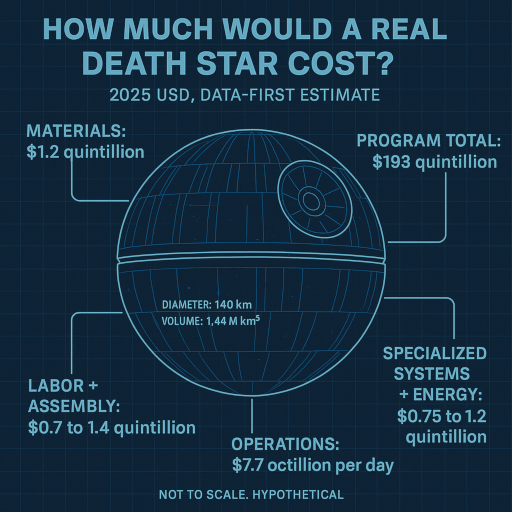
Share this post


We begin at the begining
Geometry and scale
- Diameter: 140 km baseline, with 160 km cited in some sources
- Volume: ~1.44 million km³
- Mass: ~1.08 × 10^15 tonnes, using a warship-like density model
Core capabilities
- Planet-destroying superlaser, star-class reactor, hyperdrive, heavy defenses, housing for 1 to 2 million personnel
Cost anchors, 2025 dollars
- Materials (steel baseline): ~$1.2 quintillion
- Labor and assembly: $0.7 to 1.4 quintillion
- Specialized systems and energy tech: $0.75 to 1.2 quintillion
- Component subtotal from this build-up: ~$2.65 to 3.8 quintillion
- Program-level totals in the literature: ~$100 to 500 quintillion
- Flagship comprehensive estimate: ~$193 quintillion
- Daily operations: ~$7.7 octillion per day
- Annual operations: ~$2.8 nonillion
Macro context
- $193 quintillion is roughly 2,300 times Earth’s 2025 GDP (~$84 trillion)
- Destruction of such an asset could trigger a 15 to 30 percent economic contraction in a galactic-scale economy
Ground Rules and Assumptions
To avoid fantasy accounting, the article adheres to the constraints you set:
- No magic tech in the spreadsheet. We price real analogs. Where the fiction demands the impossible, we treat the number as a proxy for a research program of unprecedented size.
- Warship-like density, not a solid sphere. This corrects the classic overestimate that results from filling a 140 km ball with solid steel.
- Materials priced like steel. Quadanium may be canon, but steel is what we can price today.
- Inflation normalized. Figures adjusted from 2012 anchors to 2025 levels using a cumulative change of roughly 39 percent.
- Human industrial reality. Global steel output is about 1.3 billion tonnes per year. That throughput dominates any schedule that pretends this is an Earth-only project.
- Scope exclusions. Environmental costs, ethics, and interstellar politics are outside the ledger. We also exclude faster-than-light logistics, except to note that hyperdrive has a placeholder cost in the specialized systems bucket.
These premises keep the accounting consistent. They also illuminate the core insight of the research: even before the superlaser enters the chat, the world runs out of steel, time, and patience.
Component 1: Materials
Steel requirement: ~1.08 × 10^15 tonnes Steel baseline cost: ~$1.18 quintillion after inflation, rounded to $1.2 quintillion
Why materials dominate
The Death Star is first and foremost a structure. Most costs in conventional megaprojects arise from integrating many expensive systems into a modest amount of structure. Here the ratio flips. Even with generous voids, the trusses, pressure hulls, decks, and armor stack up to the kind of mass that only planetary mining can satisfy.
Production bottleneck
- World output: ~1.3 billion tonnes of steel per year
- Years to produce the mass: ~833,315 years, before considering fabrication, transport, or assembly
Alternative materials
- Aluminum and carbon composites: Potentially 50 to 80 percent cheaper per kilogram in structural applications, which suggests ~$200 to 500 quadrillion for the structure.
- Caveat: A 140 km pressure vessel that survives combat and micrometeoroids requires strength, fracture toughness, fatigue resistance, radiation tolerance, and thermal stability. Composites help in specific subsystems but struggle as an all-up replacement for a battle station hull.
- Electronics, sensors, and exotics: Add $10 to 50 quadrillion for wiring, radiation shielding, avionics racks, and any exotic crystal stand-ins for kyber control systems.
Materials subtotal to carry: ~$1.2 quintillion, plus 10 to 20 percent for reinforcement and system integration.
Component 2: Labor, Assembly, and Schedule
Labor scaling anchor: ISS, ~$150 billion for roughly 1,000 m³ of habitable volume Death Star internal volume: ~1.44 × 10^12 m³ Implied worker-hours: into the trillions Labor cost: ~$500 quadrillion to $1 quintillion at an average of $50 per hour
Assembly and access to orbit
- Historical to present-day launch economics: $10,000 to $20,000 per kg to orbit for heavy hardware when averaged across program lifetimes and long-tail integration costs
- Assembly logistics cost: ~$200 to 400 quadrillion
Although modern commercial launchers have compressed the marginal price of a kilogram to low Earth orbit for some vehicles, the integration reality of a moon-sized military habitat is not a rideshare payload. You need a dedicated industrial supply chain, space docks, tugs, tankers, and construction yards, plus the drydock equivalent of a small nation’s port infrastructure, except in microgravity.
Time, the most punishing constraint
- Materials alone take >833,000 years at Earth production rates
- Even with parallel asteroid mining and automated yards, the system integration curve suggests centuries for a single unit
- Canon claims a build time near 20 years for the first Death Star. Accept that as narrative shorthand for galaxy-scale parallelization and wartime coercion, not as an engineering forecast
Labor and assembly subtotal to carry: ~$0.7 to 1.4 quintillion
Component 3: Energy Systems and Specialized Technology
This is where the fiction meets the spreadsheet and decides to negotiate.
Reactor
- Analog: Fusion research at ITER scale costs tens of billions for a device that does not meaningfully power a city
- Scaled program: A star-class output is beyond any civilian analog, so we treat it as an ultra-program with ~$100 to 500 quadrillion in R&D, exotic fuels, containment, and facilities
Superlaser
- Energy target: Planetary disruption orders near 10^32 joules in common back-of-the-envelope estimates
- R&D and systems integration: ~$50 to 200 quadrillion, and that is just to purchase the most optimistic possible science program with prototype arrays and a safe test range somewhere that is not your home planet
Everything that keeps people alive and the station safe
- Life support scale up from ISS: ~$100 quadrillion, not because oxygen is pricey but because redundancy, radiation mitigation, waste management, food production, and water handling all scale with area and headcount
- Defenses: ~$200 quadrillion for shield generators, point defense, armor belt hardening, hangars, and sensors
- Hyperdrive analogs: ~$300 quadrillion as a placeholder for faster-than-light infrastructure at the battle station scale
Tech and energy subtotal to carry: ~$0.75 to 1.2 quintillion
Two Totals, Two Stories
-
Bottom-up component subtotal Add the three big buckets and you land at ~$2.65 to 3.8 quintillion. This is the sober, engineering-first view that prices what you can tabulate.
-
Program-level macro estimate Real megaprojects never equal the sum of their parts. Financing, risk, schedule slips, political padding, logistics, supply shocks, and loss events dominate. That is why the literature points to ~$100 to 500 quintillion for a full program, with a widely cited figure of ~$193 quintillion.
The second number is not a contradiction. It is a recognition that once you mobilize a civilization to build a weaponized moon, costs begin to behave like macroeconomics, not line items.
Operating Costs: The Daily Burn
Total daily cost: ~$7.7 octillion
Annualized: ~$2.8 nonillion
Breakdown
- Reactor fuel or hyperfuel equivalent: ~$5 octillion per day
- Maintenance and spares: ~$1 octillion per day
- Crew, logistics, and consumables: ~$1 octillion per day
- Other overhead: ~$0.7 octillion per day for shields, communications, computing, and navigation
Note the logic rather than the literal value. These figures accept the premise that you are channeling stellar energy through machinery under human supervision. Even if the superlaser fires rarely, keeping reactors hot, capacitors conditioned, and shields available consumes energy at rates that human industry cannot conveniently imagine.
Sensitivity: What Changes When You Change the Dial
Diameter: 160 km instead of 140 km
Volume scales with the cube of radius. Increasing diameter from 140 to 160 km is about a 14.3 percent increase in diameter and about a 39 percent increase in volume. That pushes material mass, logistics mass, and most cost categories up by nearly the same factor. A steel baseline of $1.2 quintillion becomes ~$1.7 quintillion before considering second-order effects like thicker armor needed to preserve the same relative survivability.
Materials mix
Shifting 30 percent of structural mass to composites or aluminum cuts mass and might trim hundreds of quadrillions from the bill. The penalty appears later in lifecycle cost, because radiation, thermal cycling, and impact damage will push maintenance and replacement rates up. The OPEX line can eat the CAPEX gains.
Automation and crew size
Replace half the crew with autonomous systems and you trim salaries, food, and habitats by a meaningful fraction. Maintenance does not vanish. Remote and robotic maintenance is equipment intensive and tends to be traded for more redundancy, not less, which increases upfront costs and spares. The operating budget is dominated by energy anyway.
Launch economics
Even if marginal launch cost falls by an order of magnitude through full reusability and on-orbit propellant depots, the assembly line still faces the basic fact that you are hauling and joining a planetary mass of metal. Logistics improvements matter most at the beginning and the end of the program. They do not erase the middle.
Industrial Architecture: How You Would Try It If You Had To
A realistic plan would not launch steel plates from Earth. It would establish a supply chain that looks like this:
-
Resource capture in space Mine iron and nickel from M-type asteroids. Set up smelters that run on concentrated solar power or reactor heat. Produce ingots, coils, and truss members in zero-g factories.
-
Orbital shipyards Build modular drydocks at stable orbits, likely with shielded worker habitats. Add robot gantries, welding drones, and autonomous inspection swarms. Early modules assemble into pressurized volumes that become both factory space and eventual living quarters.
-
In-situ fabrication Roll sheets, extrude beams, and print complex fittings on site. Treat every kilogram of delivered raw feedstock as a kilogram of finished structure, not a kilogram of packaging.
-
Test articles and destructive testing Before full-rate production, build ten-kilometer-class hull sections and push them to failure under thermal, vibrational, and impact loads. You do not want to discover a panel resonance mode after you mount a superlaser.
-
Segmented assembly Construct the battle station as a lattice of independent pressure sections. Each section can be sealed and isolated during damage control. This increases weight but pays for itself in survivability and maintainability.
-
Systems integration Install power buses, coolant loops, environmental control systems, shield emitters, communications relays, sensor arrays, and weapons. Prove every ring of the station to partial combat readiness before closing the sphere.
-
Commissioning Bring reactor output up in steps, cycle the superlaser capacitors without firing, exercise shields at increasing power levels, then attempt a low-yield test on a harmless target like a dead comet. If the comet disappears in a puff of plasma and the station survives the backblast, you graduate.
Each step costs on the order of national budgets for modern countries. Several steps run in parallel and require their own high-reliability supply chains. The overall program lives or dies based on whether the shipyards can keep a predictable rhythm in the face of near-constant design changes.
Risk, Contingency, and Insurance That Does Not Exist
Civil megaprojects often carry contingency of 20 to 50 percent for unknowns. Military programs tend to run higher once secrecy, accelerated schedules, and evolving requirements enter. For a battle station, sensible contingency would be 100 percent on early work packages, trimming to 50 percent on mature production. That single line item is one reason the literature converges on totals that soar above the component subtotal in your spreadsheet.
Insurance is not a market that can accept this risk. The effective alternative is imperial self-insurance, either through reserve funds or socialized loss. That means the macroeconomy absorbs every misstep directly, which raises the long-run cost through interest and crowding-out effects.
Financing the Unfinanciable
At $193 quintillion, everything about financing becomes strange. Interest on that principal at even modest rates stacks into the multi-quintillion range over decades. If the issuer funds the program through a combination of taxation, bond issuance, and forced industrial participation, the side effects include:
- Crowding out of civilian investment and research
- Inflationary pressure in commodities, energy, and skilled labor markets
- Supply chain fragility, since the program creates single points of failure for exotic components
- Political lock-in, because too many worlds or regions become dependent on the program to walk away
This is the macro story behind the research finding that a catastrophic loss of the asset can trigger a 15 to 30 percent recession. The real damage is not the explosion. It is the cascade through finance, employment, and interplanetary trade.
Operations and Maintenance: The Forever Budget
Even if the station never fires its superlaser, it is a city-state that lives in hard vacuum. Major drivers include:
-
Propulsion and station-keeping A 140 km sphere presents a healthy cross-section to solar wind and photon pressure. You will spend propellant or power to hold station, even if orbital mechanics do most of the lifting.
-
Radiation and thermal control Multilayer insulation, heat pipes, pumped loops, and radiators must dump waste heat from the reactor, shield generators, and life support. Thermal rejection is a mature problem at small scale and a brutal one at this size.
-
Consumables Closed-loop life support reduces water and air resupply, but spare parts and food never reach zero. Agriculture modules help, but they add mass and power draw.
-
Training and readiness The station is only scary if it works on a bad day. Drills, inspections, and replacements consume time and money. If you skimp, the station will remind you at the least convenient moment.
The result is an ongoing bill of ~$7.7 octillion per day in your model. The precise number is less important than the functional insight: energy throughput at stellar levels dwarfs every other cost center. Maintenance and staffing are finally visible on the spreadsheet only because the energy number is written in scientific notation.
Comparisons That Help the Brain Cope
- All human wealth: ~$500 quadrillion, which puts even the $1.2 quintillion steel bill on the far side of conceivable
- ISS equivalence: A single Death Star equals about 1.3 billion ISS-class projects
- Aircraft carriers: On the order of a trillion carriers at typical build costs, although the supply of oceans for parking becomes a separate problem.
These analogies are imperfect, but they communicate the scale in a way that a string of zeroes cannot.
Plausibility, Physics, and Why the Spreadsheet Cannot Save You
Your research makes two things clear.
First, even if every line item could be purchased with enough patience and steel, the physics of the superlaser and the energy system remain outside any current or near-term theory that can be priced like an extreme engineering program. The numbers you carry for reactor and laser are best understood as the cost to pursue the most ambitious energy research agenda in history, not the cost to buy a known device.
Second, structural integrity at 140 km with combat expectations is not a simple matter of thickness. Buckling, microcrack propagation, dynamic loads from weapons fire, thermal gradients across the hull, and impact events all combine into a design that is much heavier than a thin shell scaled up from a ship. The warship-like density and the reinforcement adders you include are vital to keep the estimate grounded.
What Affects the Story the Most
If a reader wants the two or three knobs that actually move the total, start here:
-
Materials throughput More than any cost, this is the schedule killer. Without galactic mining, the math is unsparing. With galactic mining, the math becomes someone else’s problem and the budget explodes in logistics.
-
Energy realism If the superlaser is toned down to a dramatic but non-planetary weapon, and if the reactor is a fleet of fusion plants rather than a tamed star, OPEX falls by orders of magnitude. The station is still ruinously expensive, but it becomes a battle fortress rather than a deity.
-
Program governance The gap between ~$3 quintillion and ~$193 quintillion lives here. Cost control, standardization, and modularity are the unglamorous heroes of megaprojects. Empires are not famous for any of those.
A Minimalist Alternative: What If You Aim Lower
Suppose an ambitious civilization wants something impressive, but not a planet killer.
Consider a sequence:
- Build a network of smaller defense stations of 1 to 5 km diameter, each with conventional lasers for point defense, heavy shields, and docking yards.
- Add an orbital ring or elevator per core world to speed logistics.
- Invest in long-range deterrence with unmanned platforms rather than a single target that concentrates risk.
This strategy uses lessons from your estimate. Costs scale more favorably, resilience improves through redundancy, and no single failure writes a trillion-digit check.
Sources & Inspirations (for readers who want to dig deeper)
- Centives (Lehigh University): canonical early steel-cost estimate for the Death Star and production-rate thought experiments (inflated here to 2025). Centives.net Article
- Dr. Zachary Feinstein: macro-financial modeling of the Death Star program and imperial default scenarios (basis for the ~$193 quintillion figure) BigThink.com Article.
- Real-world anchors: ISS program costs and volumes; military high-energy laser programs; fusion project budgets (ITER and peers).
Bottom Line
Your numbers tell a consistent story.
- Materials at ~$1.2 quintillion are the immovable object.
- Labor and assembly at ~$0.7 to 1.4 quintillion describe the pain of building a moon in orbit with today’s economics.
- Energy systems and specialized tech at ~$0.75 to 1.2 quintillion reveal how quickly physics turns into a budget request.
- The program total at ~$193 quintillion captures governance, risk, and macro reality.
- Operations at ~$7.7 octillion per day are a billboard that says the laws of thermodynamics still apply.
If a galactic empire spreads the spending across millions of worlds, the percentage of gross galactic product may appear modest. The fragility remains. Destroy one battle station and the credit markets will tremble.
As a work of engineering imagination, the Death Star is unmatched. As a budget, it is a cautionary tale. A civilization that can afford to build and operate one almost certainly has better things to do with its money. For everyone else, the best plan is still to enjoy the movies, argue about the assumptions, and keep your spreadsheets close.